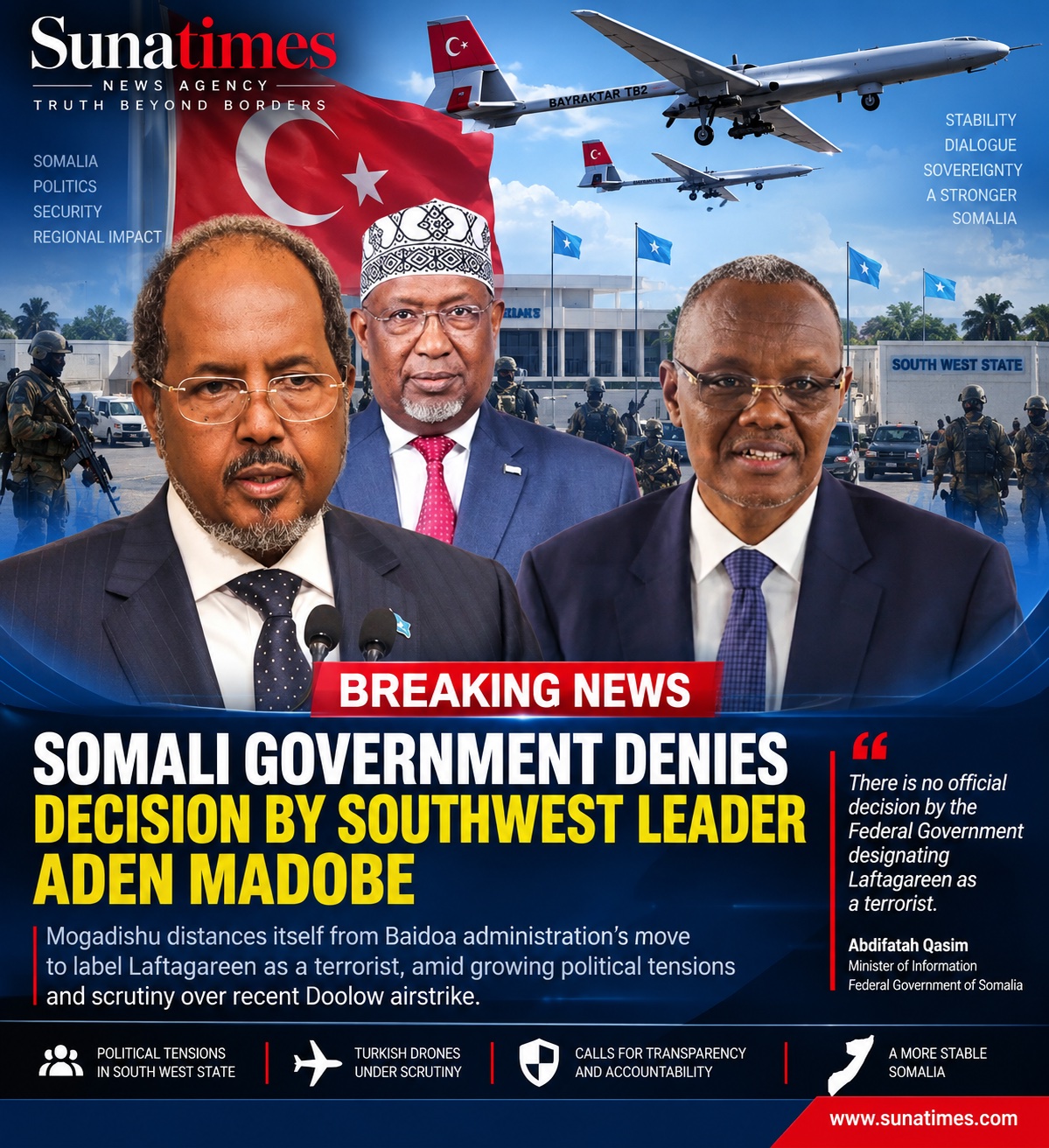
Federal Minister of Information and government spokesman Abdifatah Qasim said on Saturday that the Federal Government has nowhere officially designated Laftagareen as a terrorist.
The statement effectively challenges an earlier decision attributed to the Baidoa administration led by Sheikh Aden Mohamed Nur "Madobe,” which had associated Laftagareen and forces loyal to him with Al-Shabaab.
The clarification comes amid intense political fallout from the September 3 airstrike in Doolow that targeted the residence of former Somali Custodial Corps commander and lawmaker General Mahad Abdirahman Aden "Shub.”
General Shub survived the attack, but the incident has triggered widespread condemnation from opposition politicians and renewed questions over whether Somalia's counter-terrorism architecture is becoming entangled in domestic political disputes.
Terrorism Designation Now in Question
On August 30, the Baidoa authorities reportedly placed Laftagareen and forces associated with his former administration within a terrorism-related framework, alleging links with Al-Shabaab as tensions escalated over control of Baidoa.
Laftagareen and his supporters reject that characterisation and maintain that they constitute the legitimate political administration of South West State.
The Federal Government's latest position now creates an important distinction.
If Mogadishu does not recognise Laftagareen or his administration as terrorists, questions arise over the legal and security basis upon which political forces aligned with him could be treated as counter-terrorism targets.
The timing has made the government's clarification particularly significant.
Only four days after the reported Baidoa designation, General Shub — a senior figure associated with the political camp opposed to the current authorities — was targeted in an airstrike at his Doolow residence.
Doolow Strike Intensifies Scrutiny
Opposition figures and Jubaland have alleged that the Doolow attack was politically motivated and have accused the Federal Government and Türkiye of involvement.
Mogadishu has denied responsibility for the strike.
No independent investigation has yet publicly established who operated the aircraft, who selected General Shub as a target or who authorised the operation.
The Federal Government's denial of involvement therefore remains part of the competing accounts surrounding the attack.
Nevertheless, the sequence of events — the terrorism-related accusations against Laftagareen's camp followed days later by the strike against General Shub — has intensified opposition demands for an independent investigation.
Opposition Demands Answers
Somali opposition politicians and sections of civil society have strongly condemned the attack on General Shub.
Critics are demanding answers to several fundamental questions: who authorised the strike, what intelligence was used to identify the target, what legal authority governed the operation, and whether General Shub had ever been formally classified as a legitimate military or counter-terrorism target.
Those questions have become more consequential following Minister Qasim's statement that the Federal Government itself does not classify Laftagareen's political administration as a terrorist organisation.
The controversy also places the Baidoa authorities under pressure to explain the legal foundation and evidentiary basis for their earlier terrorism allegations.
A Political Conflict or Counter-Terrorism Operation?
At the heart of the controversy lies a larger question confronting Somalia:
Where does legitimate counter-terrorism end and domestic political conflict begin?
Somalia continues to fight Al-Shabaab, one of Africa's most dangerous militant organisations, with extensive international military and security assistance.
Any suggestion that terrorism designations or counter-terrorism capabilities could be applied to political rivals would therefore carry serious consequences for Somalia and its international partners.
The Federal Government's latest clarification may have been intended to distance Mogadishu from the controversial designation issued in Baidoa.
Instead, it could increase demands for transparency over both the designation of Laftagareen's camp and the subsequent Doolow strike.
Until an independent investigation establishes responsibility for the September 3 attack, allegations that the strike was ordered by the Federal Government or conducted for political purposes remain disputed.
But the government's own declaration that Laftagareen and his administration are not officially designated terrorists has introduced a new question into an already explosive controversy:
If they are political opponents rather than terrorists, on what legal basis could military force be used against figures associated with their political camp?
Sunatimes News Agency — Investigative Desk
Mogadishu, Somalia

 0
0















Somali Government Rejects Decision by Southwest Leader Aden Madobe
MOGADISHU, Somalia — September 5, 2026 (Sunatimes) — Somalia's Federal Government has publicly distanced itself from claims that former South West State President Abdiaziz Hassan Mohamed Laftagareen and his administration have been d