ALSO IN THE NEWS

Somalia 1991–2026: Is history repeating itself? From Aidid vs Ali Mahdi to Hassan Sheikh vs Sheikh Sharif
 0
0
Monday October 12, 2026 - 15:53:47 in Latest News by Super Admin
- Visits: 2245
-

- Share
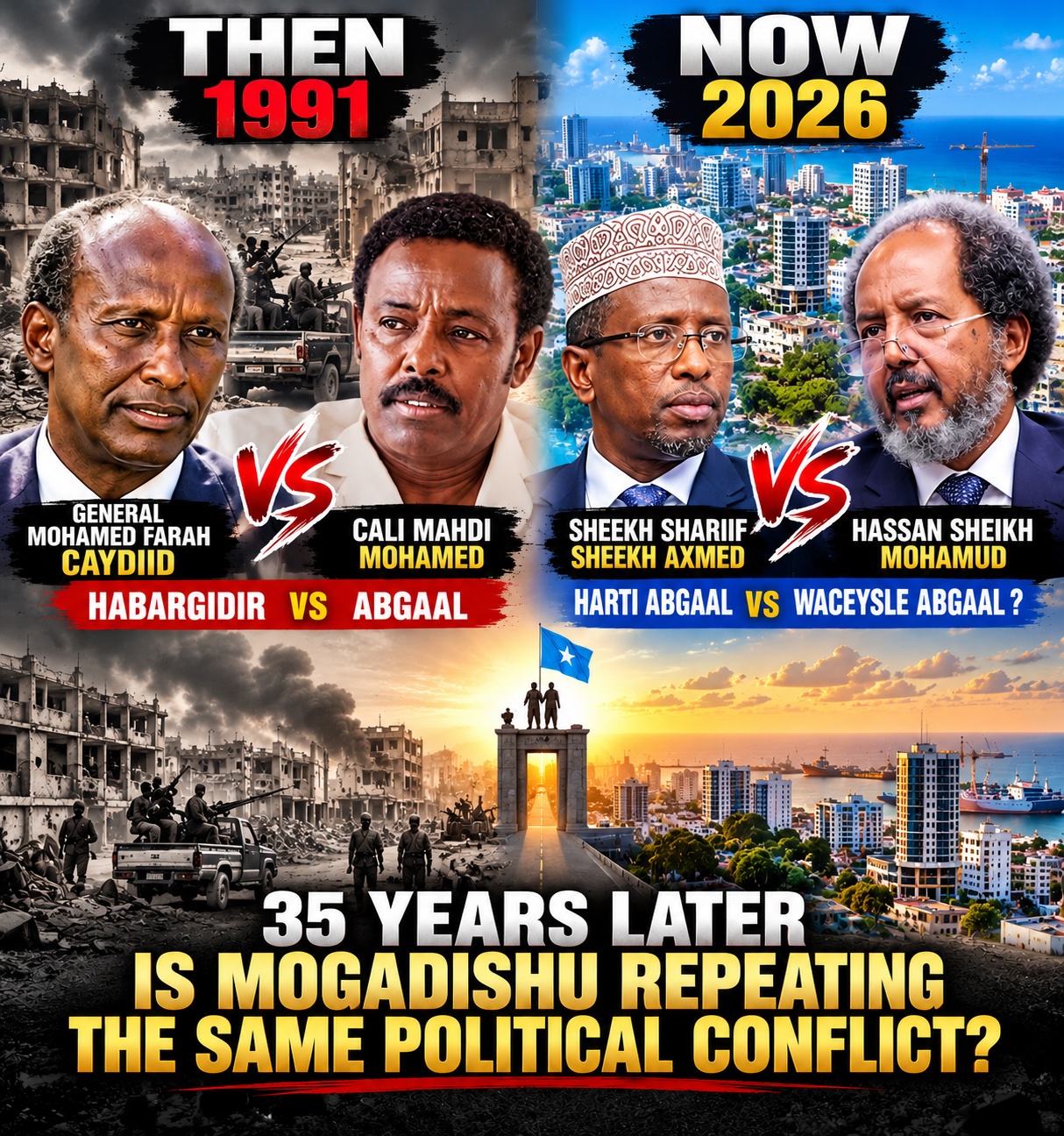

35 years later, political rivalries, clan tensions and fears of armed confrontation raise questions about Mogadishu's future.
Independent Investigative Journalism | Somalia & International Affairs
SOMALIA ON THE BRINK: Hassan Sheikh–Sharif Rivalry Revives Fears of Mogadishu’s 1991 Political Catastrophe
From General Mohamed Farah Aidid and Ali Mahdi Mohamed in 1991 to President Hassan Sheikh Mohamud and former President Sharif Sheikh Ahmed in 2026, Somalia faces renewed fears that political rivalry, armed mobilisation and clan divisions could threaten the capital’s fragile stability.
By Waagacusub Media | Investigative Political Report
MOGADISHU, SOMALIA — October 12, 2026
Somalia is confronting a dangerous escalation in political tensions as President Hassan Sheikh Mohamud and former President Sharif Sheikh Ahmed exchange accusations involving armed militias, security operations, political intimidation and alleged preparations for confrontation in Mogadishu.
The dispute has intensified following allegations by Somalia’s National Intelligence and Security Agency (NISA) that armed men associated with the former president attacked government security personnel.
Sharif has rejected the accusations, alleging instead that government forces have targeted his associates, restricted access to his residence and attempted to intimidate political opponents.
The confrontation has raised questions about whether Somalia could be approaching another period of political violence reminiscent of the destructive power struggle between General Mohamed Farah Aidid and Ali Mahdi Mohamed following the collapse of the Somali state in 1991.
Although the political circumstances differ significantly, the combination of disputed presidential authority, armed political factions and increasingly confrontational rhetoric has revived painful historical memories.
NISA Accuses Former President Sharif of Armed Provocations
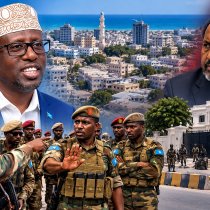
On October 11, Somalia’s National Intelligence and Security Agency publicly accused armed men allegedly operating under the authority of former President Sharif Sheikh Ahmed of attacking and obstructing its security personnel in Mogadishu’s Wadajir district.
According to the agency, armed individuals carrying assault rifles, machine guns and rocket-propelled grenade launchers entered residential properties in the Tiintiinley neighbourhood.
NISA alleged that the individuals attempted to provoke an armed confrontation with government forces.
The intelligence agency further claimed that personnel associated with the former president had previously attacked security officers on June 24, abducting an officer on duty, and obstructed another security operation on June 27.
NISA maintained that its personnel exercised restraint to prevent civilian casualties and insisted that the agency operated independently of political competition.
However, the agency’s allegations regarding the armed men’s command structure and responsibility for the incidents have not been independently verified. Dawan Africa
Former President Sharif Rejects Allegations and Accuses Government of Intimidation
Former President Sharif Sheikh Ahmed responded by rejecting NISA’s accusations and alleging that government security forces had been deployed around his residence.
His office accused the authorities of restricting access to his property and interfering with the delivery of essential supplies.
Sharif also alleged that members of his staff had been abducted.
The former president warned against the involvement of national security institutions in political rivalries, arguing that intelligence and security agencies must protect citizens without political discrimination.
His political party, Himilo Qaran, accused President Hassan Sheikh Mohamud of pursuing a confrontational strategy that could push Somalia towards renewed internal conflict.
The party called for political dialogue and a negotiated electoral agreement rather than military confrontation.
The government and opposition have presented sharply conflicting accounts, neither of which has been independently established in full. Hiiraan Online
Defence Minister Ahmed Fiqi Warns Against Opposition Militias
Somalia’s Defence Minister, Ahmed Moallim Fiqi, has intensified the political confrontation by accusing opposition figures of mobilising armed groups and attempting to destabilise Mogadishu.
In remarks reported on October 12, Fiqi alleged that opposition politicians were using claims of government intimidation as a justification for assembling militias.
He further accused unnamed opposition figures of participating in previous attempts to undermine government security, allegedly with foreign financial assistance.
The minister insisted that government forces had not initiated attacks and warned that armed groups would not be permitted to threaten the capital.
Earlier, Fiqi had accused opposition politicians of suspicious foreign contacts, including alleged connections to individuals associated with Sudan’s Rapid Support Forces.
Sharif rejected those accusations, explaining that his recent visit to the United Arab Emirates was related to family matters.
No independently verified evidence has established that the former president participated in a foreign-backed military conspiracy. Dawan Africa
Former Prime Minister Hassan Ali Khaire Warns of Another Armed Crisis
Former Prime Minister Hassan Ali Khaire has also expressed concern over reported military movements near the residences of opposition leaders.
Khaire warned that the deployment of armed forces around the homes of former national leaders could provoke violence and deepen Somalia’s political crisis.
He urged both sides to resolve their differences through negotiations rather than military pressure.
His intervention highlights the growing concern among opposition politicians that the dispute could escalate beyond political statements into direct confrontation between armed security units.
Mogadishu has already experienced violent confrontations involving government forces and opposition-linked armed groups during 2026, demonstrating the potential consequences of unresolved political disputes. Hiiraan Online
International Community Reportedly Warned of Opposition Attack Plans
The escalating confrontation has also attracted attention from Somali media organisations reporting allegations of preparations for attacks against government institutions.
SMS Somali TV claimed that the international community had been informed that opposition figures were organising attacks against the government.
The report emerged alongside NISA’s allegations against former President Sharif Sheikh Ahmed.
However, the identity of the party that allegedly communicated the warning to international partners remains unclear.
There has been no independently verified public evidence establishing that opposition leaders have approved or organised an imminent attack.
The claim therefore remains an allegation rather than a confirmed security assessment.
Nevertheless, such accusations could have serious political consequences if used to justify expanded security operations against opposition figures.
The Constitutional Dispute Behind the Crisis
At the centre of Somalia’s political confrontation is a disagreement over the duration of President Hassan Sheikh Mohamud’s mandate and the constitutional legitimacy of changes to the country’s electoral system.
The president’s original four-year mandate reached its scheduled conclusion on May 15, 2026.
However, the federal government maintains that constitutional amendments extending presidential and parliamentary terms from four to five years permit the administration to continue until May 2027.
Opposition leaders reject that interpretation, arguing that constitutional amendments should not retrospectively extend the terms of officials elected under the previous constitutional framework.
The government advocates a transition towards direct elections through political parties.
Opposition groups insist that electoral reforms require broader national consensus and negotiations involving major political stakeholders.
Talks between the government and opposition collapsed in July after the parties failed to reach agreement on electoral arrangements.
The absence of a mutually accepted electoral timetable has become a central source of instability. Somalia Today
FROM 1991 TO 2026: IS SOMALIA REPEATING HISTORY?
Yesterday: General Aidid Versus Ali Mahdi
Following the collapse of President Mohamed Siad Barre’s government in January 1991, Somalia entered a period of political fragmentation and devastating civil conflict.
Two prominent political and military leaders emerged as rivals in Mogadishu:
General Mohamed Farah Aidid, associated with the Habar Gidir community, and Ali Mahdi Mohamed, associated with the Abgaal community.
Their struggle for political authority contributed to the division of Mogadishu and prolonged armed conflict.
Political rivalry became intertwined with clan loyalties, military alliances and competition for control of strategic territory.
The consequences were catastrophic.
Thousands of civilians were killed, neighbourhoods were destroyed, families were displaced and state institutions collapsed.
The conflict demonstrated how quickly political disagreements could develop into armed confrontations when rival leaders relied on military power rather than negotiated political settlements.
Today: Hassan Sheikh Versus Sharif Sheikh Ahmed
Thirty-five years later, another confrontation is developing between two prominent Somali political figures.
President Hassan Sheikh Mohamud and former President Sharif Sheikh Ahmed are both associated with branches of the wider Abgaal community.
Hassan Sheikh is associated with Waceysle, while Sharif Sheikh Ahmed is associated with Harti Abgaal.
This has prompted discussion about whether political competition between the two leaders could acquire a narrower clan dimension.
However, there is an important distinction.
There is no verified evidence that the current political dispute constitutes an organised conflict between the Harti Abgaal and Waceysle communities.
Both communities contain people with differing political positions, and neither should be treated as collectively responsible for the actions of political leaders.
The danger lies in the possibility that politicians or armed factions could exploit clan identities to mobilise support for a confrontation rooted primarily in political competition.
The historical comparison therefore serves as a warning rather than proof that the circumstances of 1991 are being repeated.
Could the Government Seek to Disarm the Opposition Before Elections?
One of the most consequential questions emerging from the crisis concerns the possible political objectives behind security operations in Mogadishu.
Opposition leaders have accused the government of using national security institutions to weaken political rivals.
The government, meanwhile, argues that armed groups operating outside established security structures threaten public safety.
These competing narratives raise several questions.
Could the government be preparing to restrict or disarm armed groups associated with opposition leaders before announcing an electoral timetable?
Could opposition figures be strengthening their security arrangements because they fear government action?
Might the confrontation involve political calculations intended to alter the balance of power before the next presidential contest?
Or are legitimate security concerns being intensified by mutual suspicion and the absence of political dialogue?
These possibilities require independent investigation.
There is currently insufficient verified evidence to conclude that President Hassan Sheikh has ordered a coordinated operation to eliminate the opposition’s political or military influence before elections.
Nevertheless, the accusations and counteraccusations demonstrate how the absence of trust between political leaders can transform security incidents into a broader national crisis.
Elections in Baidoa, Jowhar and Dhusamareb: A Possible Political Model?
Another question concerns whether President Hassan Sheikh intends to pursue an electoral timetable resembling political processes undertaken in Baidoa, Jowhar and Dhusamareb.
Opposition politicians have expressed concerns about the administration’s approach to electoral reform and the potential exclusion of political competitors.
A future electoral timetable announced without sufficient consultation could intensify the confrontation.
The critical issue is whether Somalia’s next elections will be conducted through a broadly accepted political agreement or through arrangements disputed by major opposition groups.
Without agreement on the electoral framework, even the announcement of an election date could become another source of confrontation.
The Risk of Military Fragmentation and Secret Political Alliances
The political crisis also raises concerns about divisions within Somalia’s security institutions.
In a country where military and security structures have historically been affected by political and clan loyalties, competing instructions from political leaders could create dangerous uncertainty.
Questions have emerged about whether some military officers might refuse controversial orders, whether political figures could establish informal understandings with security commanders, and whether competing armed groups could exploit disagreements within the state.
However, allegations of secret alliances or organised military disobedience should not be presented as established facts without documentary evidence, credible witnesses or independently verified operational information.
The danger is that rumours of defections or planned attacks could themselves encourage further mobilisation.
What Is at Stake for Somalia?
Somalia is already facing significant security, economic and humanitarian challenges.
The country continues to confront the threat posed by Al-Shabaab while struggling with displacement, humanitarian funding shortages and the consequences of prolonged insecurity.
Renewed political violence in Mogadishu could divert government resources from counterterrorism operations, undermine public confidence in national institutions and threaten civilian communities.
It could also complicate international efforts to support Somalia’s security transition and long-term economic development.
Humanitarian organisations are already struggling to reach vulnerable populations affected by conflict, displacement and food insecurity. Le Monde.fr
A political confrontation that develops into sustained urban fighting would create additional risks for ordinary residents.
Conclusion: Somalia Cannot Afford Another 1991
The confrontation between President Hassan Sheikh Mohamud and former President Sharif Sheikh Ahmed represents more than a disagreement between two political leaders.
It exposes unresolved questions about constitutional authority, the independence of security institutions, the role of armed political groups and the future of Somalia’s electoral system.
The historical rivalry between General Mohamed Farah Aidid and Ali Mahdi Mohamed remains a powerful reminder of the consequences of allowing political competition to develop into armed conflict.
Yet Somalia in 2026 is not Somalia in 1991.
The country possesses federal institutions, an internationally recognised government, a national security apparatus and political mechanisms that did not exist in their present form during the collapse of the state.
These institutions provide opportunities to prevent another national catastrophe.
The immediate priority should be the prevention of armed confrontation, protection of civilians, independent investigation of security allegations and the restoration of meaningful political dialogue.
Neither the government nor the opposition should be permitted to use armed force as a substitute for constitutional political competition.
The Final Question
1991: General Mohamed Farah Aidid versus Ali Mahdi Mohamed.
2026: President Hassan Sheikh Mohamud versus former President Sharif Sheikh Ahmed.
Yesterday: Habar Gidir versus Abgaal.
Today: Could political rivalry between Harti Abgaal and Waceysle become another dangerous chapter in Mogadishu’s history?
Thirty-five years after Somalia’s devastating political collapse, the country faces a defining test.
Will its leaders learn from history, or will political ambition once again place Mogadishu’s peace and Somalia’s future at risk?
WAAGACUSUB MEDIA
Independent Investigative Journalism | Somalia & International Affairs
Publication date: October 12, 2026
Editorial note: This report distinguishes documented public statements from allegations and political analysis. Claims concerning planned attacks, abductions, foreign involvement and the intentions of political leaders remain subject to independent verification.














Somalia 1991–2026: Is history repeating itself? From Aidid vs Ali Mahdi to Hassan Sheikh vs Sheikh Sharif
35 years later, political rivalries, clan tensions and fears of armed confrontation raise questions about Mogadishu's future.