ALSO IN THE NEWS

Somalia:ASOJ accuses Somali government of digital censorship and abuse of power
 0
Monday November 09, 2026 - 19:17:02 in Latest News by Super Admin
- Visits: 1290
-

- Share
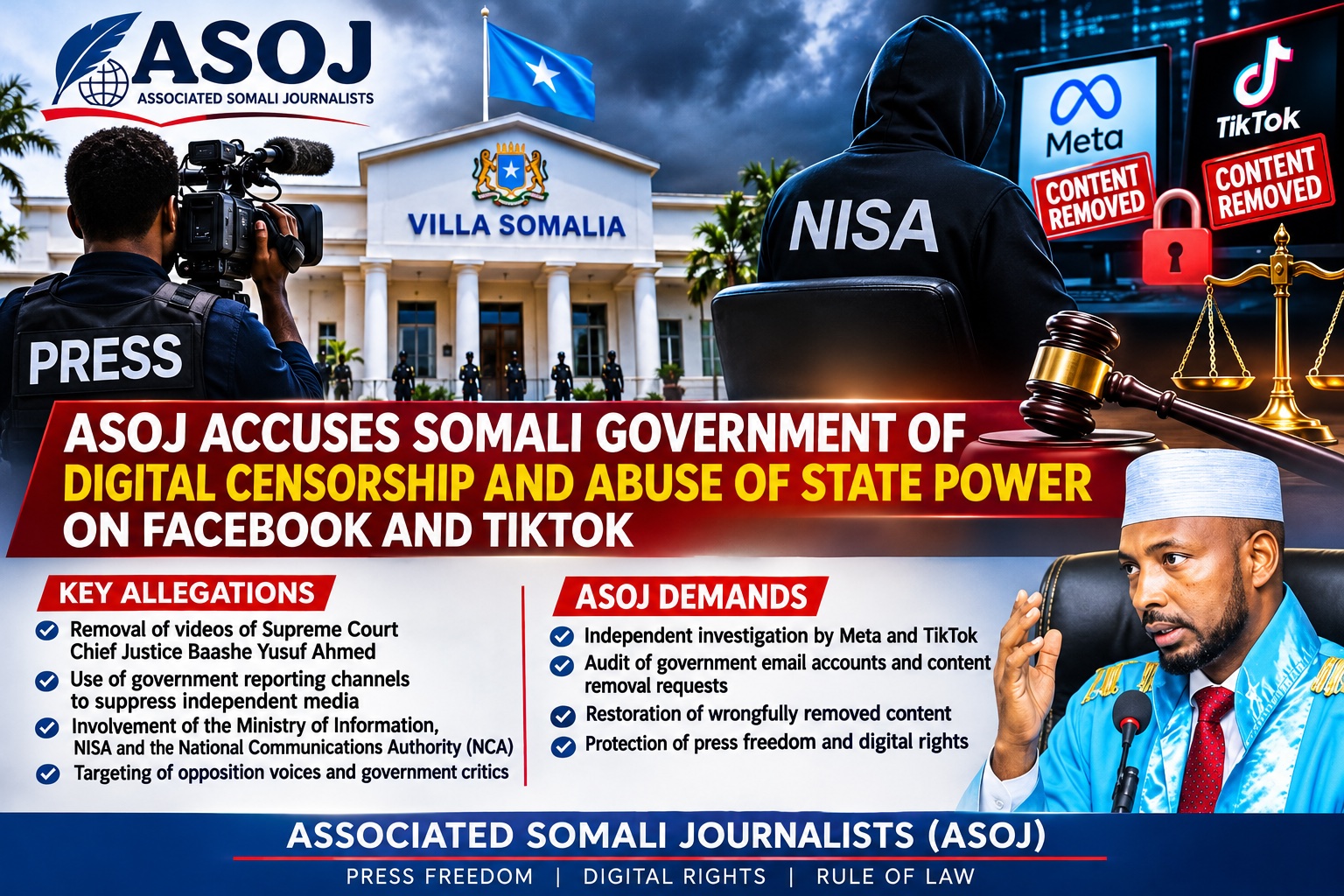

ASOJ ACCUSES SOMALI FEDERAL GOVERNMENT OF SYSTEMATIC DIGITAL CENSORSHIP AND ABUSE OF STATE AUTHORITY TO SUPPRESS INDEPENDENT JOURNALISM
OFFICIAL PRESS STATEMENT
ASSOCIATED SOMALI JOURNALISTS (ASOJ)
9 November 2026 | The Netherlands
ALLEGED MISUSE OF GOVERNMENT CONTENT REMOVAL CHANNELS ON FACEBOOK AND TIKTOK RAISES SERIOUS HUMAN RIGHTS AND RULE-OF-LAW CONCERNS
The Associated Somali Journalists (ASOJ) strongly condemns reported acts of digital censorship, political interference and suppression of independent journalism allegedly carried out by the Federal Government of Somalia through state institutions and government-authorized reporting mechanisms on major social media platforms, particularly Facebook and TikTok.
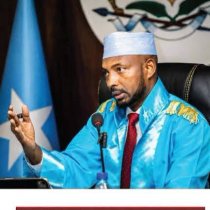
ASOJ has received reports that video statements featuring Mr. Baashe Yusuf Ahmed, Chief Justice of the Supreme Court of Somalia, have been removed from Facebook pages operated by independent media organizations.
These reported removals have occurred amid an escalating constitutional and political dispute concerning the independence of Somalia's judiciary and the constitutional limits of presidential authority.
ASOJ considers these allegations exceptionally serious because they concern not merely the removal of online content, but the possible misuse of public authority to obstruct access to information about judicial proceedings and matters of fundamental public interest.
1. ALLEGED ABUSE OF STATE INSTITUTIONS AND GOVERNMENT REPORTING PRIVILEGES
ASOJ alleges that the Ministry of Information, Culture and Tourism, the National Intelligence and Security Agency (NISA), and the National Communications Authority (NCA) have been implicated in practices intended to restrict the dissemination of politically sensitive information.
According to information reported to ASOJ, official government email addresses, institutional communications and privileged content-reporting channels may have been used to request or facilitate the removal of material published by independent journalists, opposition figures and government critics.
ASOJ is particularly concerned that reporting mechanisms intended to address genuinely unlawful or harmful content may have been used to suppress lawful political expression and legitimate public-interest journalism.
Government reporting privileges must never become instruments of political censorship.
Any deliberate submission of misleading, politically motivated or legally unfounded removal requests through official state channels would raise serious concerns about abuse of authority, procedural fairness and interference with fundamental freedoms.
ASOJ calls for an independent investigation to determine whether such practices have occurred, which institutions or officials were involved, and whether any platform enforcement decisions resulted from improper governmental pressure.
2. POTENTIAL VIOLATIONS OF INTERNATIONAL HUMAN RIGHTS LAW
ASOJ recalls that Somalia is a State Party to the International Covenant on Civil and Political Rights (ICCPR).
Article 19 of the ICCPR protects the right to freedom of expression, including the freedom to seek, receive and impart information and ideas through any media and regardless of frontiers.
Restrictions on expression must satisfy the requirements of legality, legitimate purpose, necessity and proportionality.
The suppression of lawful reporting solely because it concerns opposition leaders, judicial decisions or criticism of government authorities would be fundamentally incompatible with these principles.
Furthermore, Article 9 of the African Charter on Human and Peoples' Rights protects the right to receive information and to express and disseminate opinions within the law.
ASOJ emphasizes that criticism of public officials, reporting on constitutional disputes and publication of statements by judicial authorities are forms of expression deserving particularly strong protection in a democratic society.
Political disagreement is not a lawful basis for censorship. Public criticism is not a national security offence. Independent journalism is not a threat to the state.
3. INTERFERENCE WITH REPORTING ON THE SUPREME COURT
ASOJ expresses particular concern about the reported removal of video statements by Chief Justice Baashe Yusuf Ahmed.
Information concerning the activities, decisions and public statements of the Supreme Court is of exceptional constitutional importance.
Attempts to suppress such information, if established, could interfere with public scrutiny of the judiciary and undermine the principles of transparency, accountability and separation of powers.
ASOJ stresses that public authorities must not use their institutional influence to prevent citizens from accessing lawful information concerning the country's highest judicial body.
Where removal requests are submitted by state institutions, the legal basis, necessity and proportionality of those requests must be capable of independent scrutiny.
4. FORMAL CALL FOR INVESTIGATION BY META AND TIKTOK
ASOJ formally calls upon Meta Platforms, Inc., the operator of Facebook, and TikTok to initiate independent reviews of government-originated content removal requests relating to Somalia.
ASOJ specifically requests that both platforms:
-
Audit government reporting channels: Examine requests submitted through official Somali government email domains, authorized reporting portals and any privileged government escalation mechanisms.
-
Review removal decisions: Investigate the removal of videos featuring Chief Justice Baashe Yusuf Ahmed, together with other politically sensitive content published by independent journalists and opposition figures.
-
Examine potential abuse of authority: Determine whether government-affiliated actors submitted inaccurate, misleading, abusive or politically motivated reports to obtain content restrictions.
-
Preserve relevant records: Retain available removal requests, submission timestamps, stated legal grounds, account identifiers, moderation decisions and associated audit logs, subject to applicable law and data-protection requirements.
-
Provide transparency and accountability: Explain, where legally permissible, whether the relevant removals resulted from government requests, platform policy enforcement, automated moderation or other mechanisms.
-
Restore wrongfully removed content: Reinstate lawful journalistic material where review establishes that removal was erroneous, unjustified or inconsistent with applicable human rights standards.
-
Prevent future misuse: Establish effective safeguards against abusive government reporting, including enhanced scrutiny of requests targeting political speech, journalism and judicial institutions.
ASOJ further urges both platforms to ensure that government reporting privileges are not treated as automatic evidence of illegality or as grounds for removal without appropriate independent assessment.
5. RESPONSIBILITY OF THE FEDERAL GOVERNMENT OF SOMALIA
ASOJ calls upon the Federal Government of Somalia to disclose the legal and administrative basis for any official requests seeking removal of journalistic or political content from social media platforms.
The government must ensure that the Ministry of Information, NISA, NCA and all other public institutions act within their lawful mandates and respect constitutional guarantees and international human rights obligations.
Where credible evidence indicates misuse of state authority, the relevant conduct must be investigated through independent and impartial procedures, with appropriate accountability for proven violations.
National security powers cannot lawfully be invoked as a blanket justification for suppressing peaceful political criticism or independent reporting.
6. CALL FOR INTERNATIONAL HUMAN RIGHTS OVERSIGHT
ASOJ urges the United Nations Office of the High Commissioner for Human Rights (OHCHR), relevant UN Special Procedures, the African Commission on Human and Peoples' Rights and international press freedom organizations to examine the reported pattern of digital censorship in Somalia.
Particular attention should be given to whether government-originated platform reporting mechanisms are being used to restrict constitutionally significant information and undermine independent media organizations.
ASOJ also encourages international stakeholders to assess these allegations in light of the UN Guiding Principles on Business and Human Rights and the responsibility of technology companies to respect human rights.
7. ASOJ'S FINAL POSITION
The Associated Somali Journalists unequivocally rejects the weaponization of state institutions, intelligence capabilities or privileged digital reporting mechanisms against independent journalism.
No government should be permitted to transform social media content moderation systems into instruments for silencing judicial authorities, political opponents or journalists exercising their legitimate professional responsibilities.
The reported removal of statements by Somalia's Supreme Court Chief Justice demands a credible, transparent and independent examination.
ASOJ calls on Meta and TikTok to act without political favoritism, protect legitimate public-interest reporting and ensure that their platforms cannot be exploited through improper state pressure.
Freedom of the press is a fundamental right, not a privilege granted by those in political power.
State authority must serve the law, not suppress those who report on it.
ASOJ will continue to document allegations of digital censorship, seek accountability and defend the rights of journalists and the public to access information without unlawful interference.
ASSOCIATED SOMALI JOURNALISTS (ASOJ)
Independent Journalism | Press Freedom | Digital Rights | Rule of Law
Official Statement — 9 November 2026
Verification note: The allegations concerning specific Somali government institutions, the use of privileged reporting channels and the causes of particular content removals have not yet been independently established. ASOJ requests investigation and disclosure of the relevant evidence rather than presenting institutional responsibility as a judicially proven fact.












Somalia:ASOJ accuses Somali government of digital censorship and abuse of power
ASOJ ACCUSES SOMALI FEDERAL GOVERNMENT OF SYSTEMATIC DIGITAL CENSORSHIP AND ABUSE OF STATE AUTHORITY TO SUPPRESS INDEPENDENT JOURNALISM