ALSO IN THE NEWS

Ethiopia Weighs Stronger Central Rule as Abiy Eyes Major Federal Overhaul
 0
0
Saturday September 05, 2026 - 17:04:22 in Latest News by Super Admin
- Visits: 5351
-

- Share
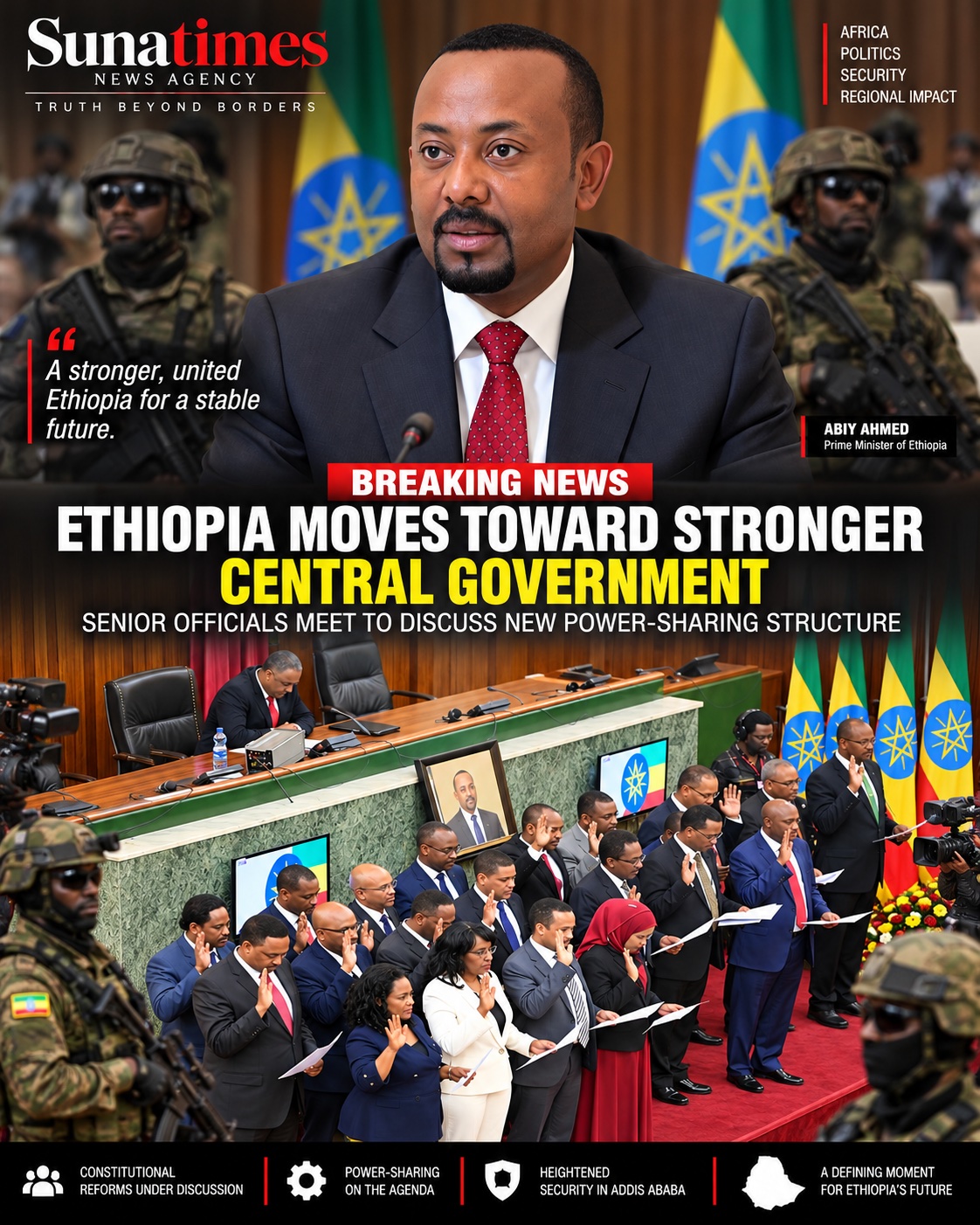

ADDIS ABABA, Ethiopia — September 5, 2026 (Sunatimes) — Ethiopia is entering a potentially historic restructuring of its political system as Prime Minister Abiy Ahmed's government considers reforms that could strengthen central authority and significantly reshape the ethnic-based federal order that has governed the country for more than three decades.
Sources familiar with ongoing government discussions told Sunatimes News Agency that senior officials are currently examining the future distribution of powers between the federal government and Ethiopia’s regional states, with proposals favouring a considerably stronger central government.
The information provided to Sunatimes has not yet been independently confirmed through an official government announcement. However, it comes at a critical moment: Ethiopia’s recently concluded National Dialogue has formally placed the structure of the state, federal-regional division of powers, fiscal federalism, regional boundaries and self-determination at the centre of the country’s constitutional debate.
Executive Presidency Could Transform Ethiopia
One of the most consequential recommendations emerging from the National Dialogue is the creation of a powerful executive presidency, merging the offices of prime minister and president.
More than 4,000 delegates participated in the dialogue, which concluded on August 22. Reports indicate that delegates overwhelmingly backed the executive-presidency proposal. The recommendations could reach parliament when lawmakers reconvene in October.
If adopted, the change would represent one of Ethiopia’s most significant constitutional transformations since the current federal system was established in the 1990s.
Supporters argue that a powerful national presidency could provide unified leadership capable of transcending ethnic and regional divisions.
Critics see something very different: a potential concentration of political authority at the centre and, ultimately, in the hands of Abiy Ahmed.
Political analyst Befekadu Hailu has warned that the proposed arrangement could effectively concentrate executive power in one individual.
Ethnic Federalism Under Pressure
The implications extend beyond changing the title of Ethiopia’s chief executive.
The National Dialogue agenda explicitly included the type of state structure, the right to self-determination, federal-regional relations, division of powers, fiscal federalism, resource allocation and the boundaries and formation of regional states.
Separate reporting has characterised Abiy’s broader constitutional project as an effort to begin dismantling or substantially reworking Ethiopia’s existing ethnic federation.
The National Dialogue has also recommended reducing government funding for political parties organised primarily along ethnic lines while favouring parties with broader national structures — another potentially significant departure from the political architecture created under Ethiopia’s current federal order.
This does not mean that Ethiopia has abolished federalism.
Earlier deliberations indicated substantial support for retaining a federal state while restructuring aspects of the ethnic-based model, including proposals to reconsider how regional states and boundaries are organised.
The question is therefore increasingly becoming not whether Ethiopia will remain formally federal, but how much meaningful political, fiscal and security authority its regional states will retain if the proposed reforms proceed.
Intelligence Sources Point to Centralisation Debate
According to sources who spoke to Sunatimes, discussions now taking place within government circles go directly to that question.
The sources described deliberations over a new distribution of authority that would leave the federal government substantially stronger in relation to regional administrations.
Sunatimes is withholding the identities of the officials because they were not authorised to discuss the internal deliberations publicly.
Their account cannot yet be independently verified. Nevertheless, the substance of what they describe closely overlaps with issues publicly documented in the National Dialogue process.
The Ethiopian National Dialogue Commission confirmed in August that participants reached consensus across all eight major agenda pillars, including government structure and political system, nation-building, institutional reform and federal-city arrangements.
What Would It Mean for the Regional States?
Any substantial redistribution of federal power could have profound implications for Oromia, Amhara, Tigray, the Somali Regional State, Afar and Ethiopia’s other constituent regions.
Under Ethiopia’s existing constitutional architecture, regional states are not simply administrative provinces. They form the constituent units of the federation and exercise constitutionally defined political powers.
A stronger central government would therefore raise fundamental questions over regional autonomy, control of security institutions, taxation and revenue, natural resources, political representation and the constitutional right to self-determination.
These issues are particularly sensitive because Ethiopia continues to face armed and political tensions in several regions.
The country is consequently attempting constitutional restructuring while simultaneously managing deep disputes over ethnicity, territory, political representation and the relationship between Addis Ababa and regional governments.
Abiy’s Biggest Political Gamble?
Abiy Ahmed has governed Ethiopia since 2018, and his Prosperity Party secured another overwhelming parliamentary majority in the June 2026 elections. The proposed executive presidency would therefore emerge in a political environment in which his party already dominates the federal legislature.
That has intensified concerns among critics that constitutional restructuring could institutionalise an already powerful central leadership.
Supporters, however, argue that Ethiopia’s existing political architecture has entrenched ethnic competition and contributed to repeated conflict, and that stronger national institutions could provide greater stability.
The disagreement therefore goes to the heart of Ethiopia’s future:
Should Ethiopia continue as a highly decentralised multinational federation, reform ethnic federalism while preserving substantial regional autonomy, or move toward a much stronger central state?
For the moment, Ethiopia legally remains a federal state.
But the combination of the executive-presidency proposal, debate over federal-regional powers, proposed changes affecting ethnic political parties and the information now emerging about internal discussions suggests that the architecture of Ethiopian federalism is facing its most consequential reassessment in decades.
The next critical stage is expected when the recommendations move toward Ethiopia’s federal parliament.
Sunatimes News Agency — Investigative Desk
Addis Ababa / Horn of Africa Desk




















Ethiopia Weighs Stronger Central Rule as Abiy Eyes Major Federal Overhaul
ADDIS ABABA, Ethiopia — September 5, 2026 (Sunatimes) — Ethiopia is entering a potentially historic restructuring of its political system as Prime Minister Abiy Ahmed's government considers reforms that could strengthen central autho