ALSO IN THE NEWS

Somalia: Corruption Legalized and Granted Immunity
 0
0
Tuesday August 11, 2026 - 17:48:45 in Latest News by Super Admin
- Visits: 3452
-

- Share
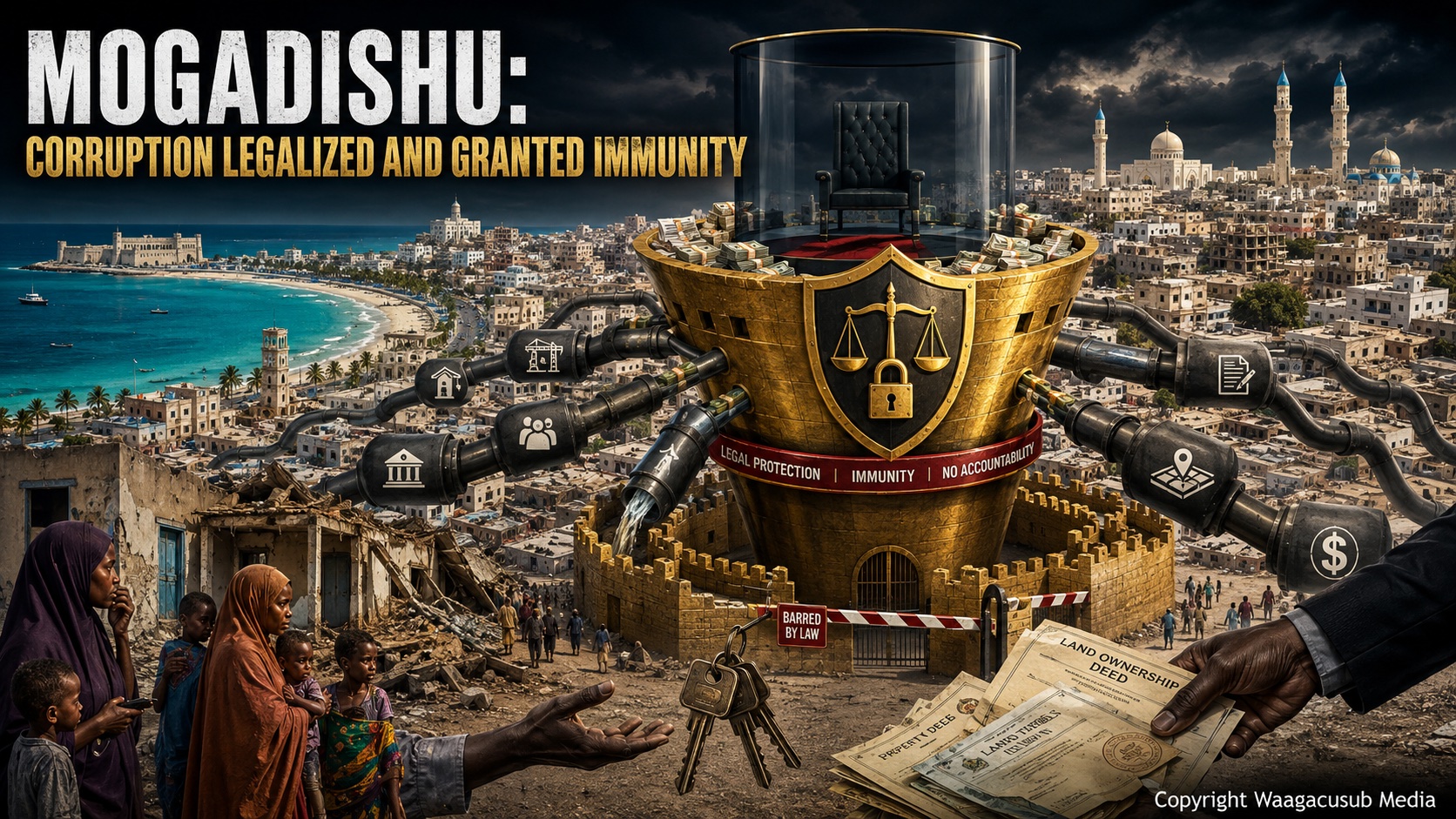

MOGADISHU — For decades, corruption in Somalia was widely regarded as a problem spread across numerous government institutions, ministries and public offices. Today, however, many residents and critics believe that the system has changed: corruption has allegedly become increasingly centralized, politically protected and disguised as lawful government policy.
In Mogadishu, low-income families say they are losing legally occupied homes and valuable plots of land while wealthy and politically connected individuals continue to expand their control over public and private property. Citizens who challenge these actions frequently describe intimidation, administrative obstruction and a justice system that appears unable—or unwilling—to protect them.
For years, the greatest fear confronting Mogadishu’s population was the threat of bombings and targeted attacks by Al-Shabaab. That danger has not disappeared. Yet many residents now say they face another devastating threat: the loss of their homes, land and livelihoods through decisions carrying official signatures, government stamps and the protection of state institutions.
This represents a disturbing transformation. What was once conducted secretly is now allegedly being implemented through decrees, administrative orders and security operations. Property seizure is presented as redevelopment. Forced displacement is described as enforcement. Political protection is treated as immunity.
Corruption Concentrated at the Centre
Previously, corruption was perceived as being distributed among ministers, senior officials, local authorities and security commanders. Various centres of influence competed for access to public money, land and government contracts.
Critics now allege that these channels increasingly lead towards one powerful centre. Major financial decisions, land allocations, public contracts and political appointments are said to depend on the approval of a small, protected circle operating at the highest level of government.
This concentration of authority weakens independent institutions and removes meaningful oversight. When Parliament, the judiciary, security agencies and financial institutions cannot investigate the executive freely, corruption no longer functions merely as individual misconduct. It risks becoming an organized system of governance.
The Poor Pay the Highest Price
The greatest victims are not powerful politicians or wealthy businesspeople. They are families who have lived in their homes for decades, small traders struggling to survive, internally displaced communities and citizens who lack the political connections necessary to defend their property.
A wealthy individual can hire lawyers, contact senior officials and negotiate with the authorities. A poor family facing eviction may have nothing except an ownership document, a house key and the hope that the law will protect them.
When that protection disappears, the law becomes a weapon in the hands of the powerful rather than a shield for the vulnerable.
The consequences extend beyond the immediate loss of property. Displaced families lose access to schools, employment, community support and basic security. Children grow up believing that legality provides no protection and that political connections matter more than justice.
Silence Through Intimidation
Journalists, activists and ordinary citizens who speak about alleged corruption often face pressure, threats or accusations of undermining the government. This climate discourages victims from reporting abuses and allows questionable decisions to proceed without meaningful scrutiny.
Criticism of public officials is not an attack on the Somali state. Accountability strengthens national institutions; silence protects those who misuse them.
No president, minister or public official should be above investigation. Political office must never provide immunity from questions concerning public money, government land or the unlawful displacement of citizens.
An Urgent Need for Accountability
Somalia’s federal institutions must establish transparent procedures governing public land, demolitions, compensation, procurement and government contracts. Every affected family should have access to an independent court before eviction or demolition takes place.
Parliament should investigate allegations of centralized corruption and unlawful property seizure. The judiciary must be able to act without political interference. Journalists and whistleblowers must be protected, and all major government contracts and land transfers should be publicly disclosed.
Somalia cannot build a stable future when ordinary citizens fear both terrorism and the institutions that are supposed to protect them.
Corruption becomes most dangerous when it no longer hides—when it receives official approval, legal protection and political immunity. Mogadishu’s residents deserve a government that protects their homes, respects their lawful rights and treats public authority as a responsibility, not an opportunity for private enrichment.
Copyright © Waagacusub Media























Somalia: Corruption Legalized and Granted Immunity
MOGADISHU — For decades, corruption in Somalia was widely regarded as a problem spread across numerous government institutions, ministries and public offices. Today, however, many residents and critics believe that the system has changed: corru