ALSO IN THE NEWS

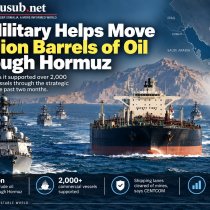
US Helps Move 1 Billion Barrels Through Hormuz
 0
0
Sunday September 20, 2026 - 03:13:43 in Latest News by Super Admin
- Visits: 2203
-

- Share
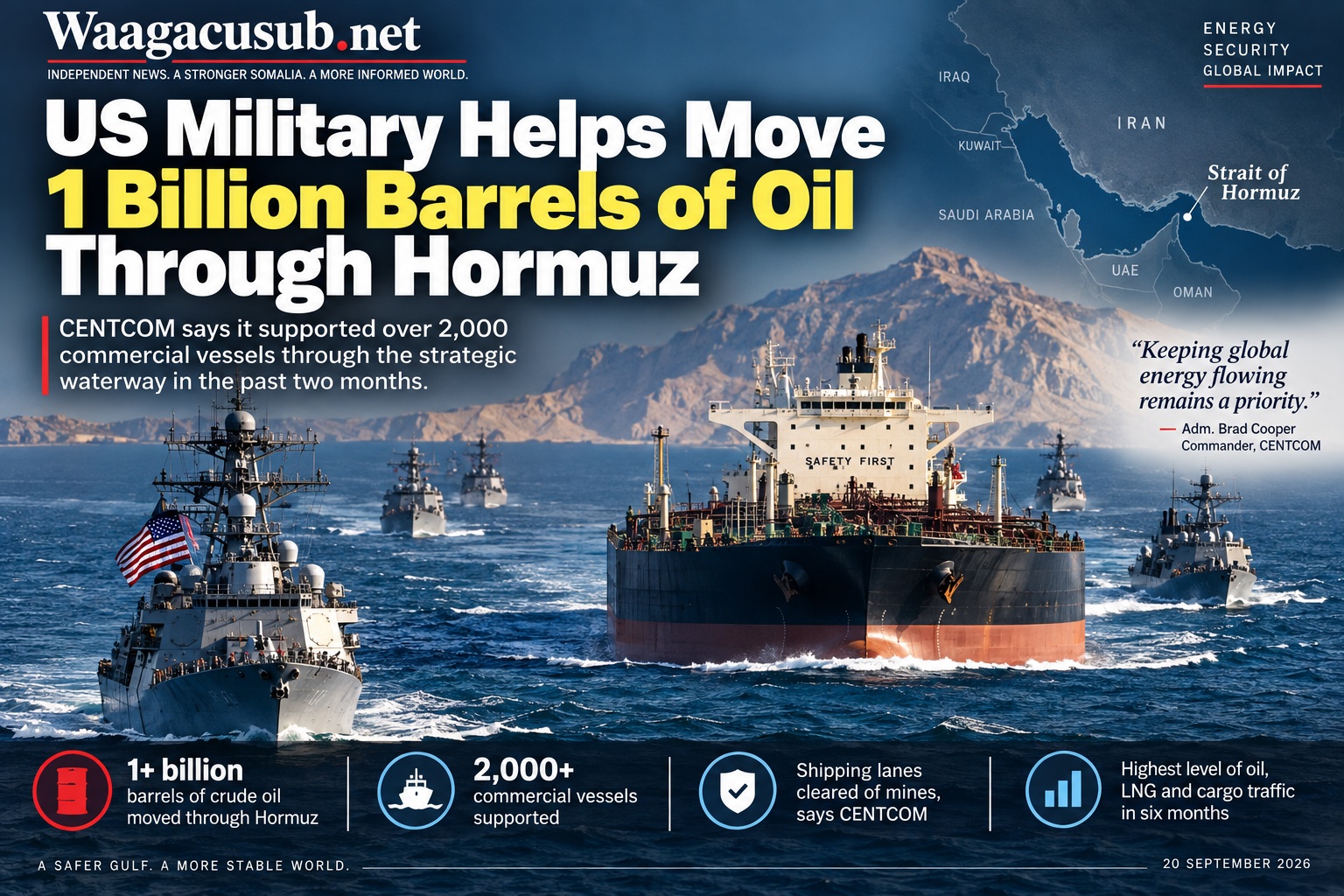

More than one billion barrels of crude oil have moved out of the Gulf through the Strait of Hormuz with support from the United States military over the past two months, according to the commander of U.S. Central Command, highlighting the extraordinary military effort underway to keep one of the world's most important energy corridors open.
By Dahir Alasow
20 September 2026
Admiral Brad Cooper, commander of U.S. Central Command (CENTCOM), said American forces had provided coordinated protection for more than 2,000 commercial vessel transits through the strategic waterway while supporting the movement of the vast volume of crude.
The figures offer a striking measure of the economic stakes surrounding the Strait of Hormuz, where war, naval operations, mines and attacks on commercial shipping have disrupted normal maritime traffic.
CENTCOM says the main shipping lanes through the strait have now been cleared of mines and that thousands of vessels have successfully made the passage.
According to Cooper, the volume of crude oil, liquefied natural gas and other cargo moving through Hormuz during the past two weeks has reached its highest level in six months.
The figures, however, come from the U.S. military and have not been independently verified in full.
A Military Shield Around the World's Energy Lifeline
The Strait of Hormuz is a narrow maritime passage connecting the Gulf with the Gulf of Oman and the Arabian Sea.
Its significance extends far beyond the Middle East.
Before the current war began, roughly 20 percent of the world's daily crude oil and liquefied natural gas supply passed through the strait, making any prolonged disruption capable of affecting fuel prices, shipping costs and economies thousands of kilometres away.
The United States launched a major maritime security effort earlier this year aimed at restoring commercial navigation through the waterway.
Under what CENTCOM calls Project Freedom, U.S. military support has included guided-missile destroyers, aircraft, unmanned systems and thousands of military personnel tasked with protecting commercial navigation.
Mine-clearance operations have also played a central role.
CENTCOM began operations in April to establish safe shipping lanes after accusing Iran's Islamic Revolutionary Guard Corps of laying mines in the waterway.
The United States says those operations have gradually allowed more commercial vessels to return.
Shipping Is Recovering — But Risks Remain
The latest military figures suggest a substantial recovery in energy movements through Hormuz, but the broader picture remains fragile.
Independent shipping data reported by Reuters earlier this week showed commercial traffic through the strait still dramatically below normal pre-war levels.
Before the conflict began on February 28, approximately 125 large commercial vessels crossed Hormuz each day, including oil tankers, LNG carriers, bulk carriers and container ships.
Recent traffic has at times fallen to only a fraction of that level.
The discrepancy illustrates the unusual situation now confronting global shipping: enormous quantities of energy are moving through the Gulf, but through a maritime corridor operating under intense military protection and persistent security threats.
Washington Says Iranian Oil Exports Have Been Halted
Cooper also made another significant claim.
While Gulf partners have moved more than one billion barrels through Hormuz, he said Iran has exported no oil through the waterway under the current U.S. naval blockade.
Washington resumed its blockade of maritime traffic entering and leaving Iranian ports in July.
CENTCOM describes the measure as an "ironclad blockade,” while maintaining that commercial vessels unrelated to Iranian ports are allowed to navigate regional waters.
The claim that Iranian exports have fallen to zero is a U.S. military assertion and should be viewed in the context of the continuing conflict between Washington and Tehran.
Iran has challenged U.S. actions in the region and has continued to assert its own authority and security interests around the Strait of Hormuz.
Oil, War and the Global Economy
The battle over Hormuz is no longer simply a military contest.
It has become a struggle over the movement of energy on which much of the global economy depends.
Saudi Arabia, the United Arab Emirates, Kuwait, Qatar and other Gulf producers rely heavily on regional maritime routes to reach international markets.
Washington says it is now coordinating not only with Gulf governments but also with shipping companies and insurers in an effort to increase commercial traffic.
That cooperation is critical.
War-risk insurance premiums, attacks on tankers, mines and uncertainty over safe passage can discourage shipping even when a physical route remains open.
The U.S. military's announcement that more than one billion barrels have successfully left the Gulf therefore represents more than a shipping statistic.
It demonstrates the scale of the international effort required to keep energy moving through a waterway that has become one of the most heavily contested maritime corridors in the world.
Yet the recovery remains vulnerable.
Recent attacks on vessels and sharply fluctuating shipping traffic demonstrate that the Strait of Hormuz remains far from normal.
For global energy markets, the message from the latest figures is consequently two-sided: oil is moving again in enormous quantities — but increasingly under the protection of military power.
Waagacusub.net
By Dahir Alasow
20 September 2026















US Helps Move 1 Billion Barrels Through Hormuz
More than one billion barrels of crude oil have moved out of the Gulf through the Strait of Hormuz with support from the United States military over the past two months, according to the commander of U.S. Central Command, highlighting the extraordina