ALSO IN THE NEWS

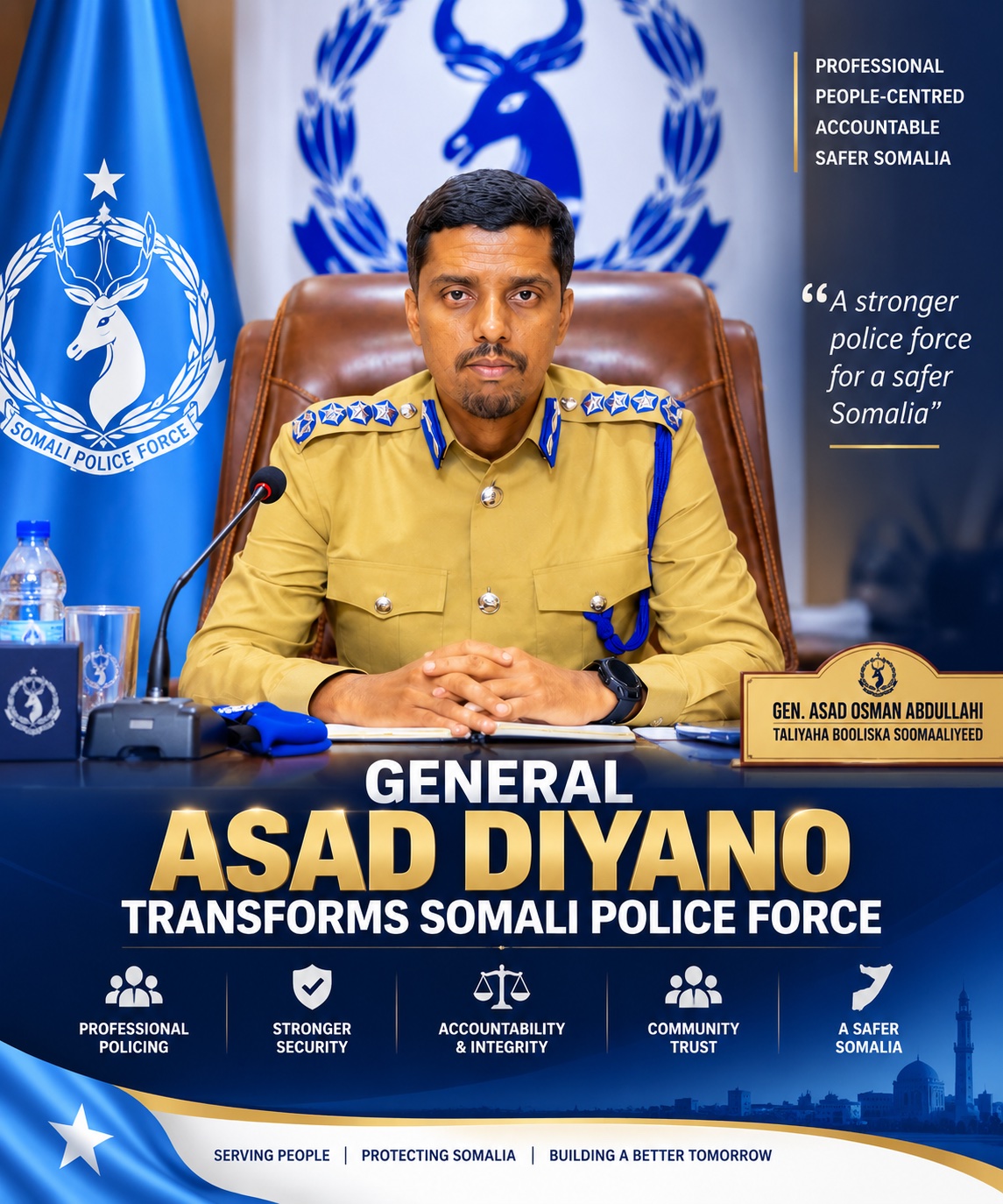
Somalia: General Asad Diyaano Transforms Somali Police Force

0
Saturday September 05, 2026 - 17:54:57 in Latest News by Super Admin
  • Visits: 304
  • (Rating 0.0/5 Stars) Total Votes: 0
  • 0 0
  • Share via Social Media

    Somalia: General Asad Diyaano Transforms Somali Police Force

    MOGADISHU, Somalia — September 5, 2026 (Sunatimes) — Nearly two years after taking command of the Somali Police Force, General Asad Osman Abdullahi, widely known as Asad Diyaano, is increasingly associated with an ambitious effort to tran

    Share on Twitter Share on facebook Share on Digg Share on Stumbleupon Share on Delicious Share on Google Plus

MOGADISHU, Somalia — September 5, 2026 (Sunatimes) — Nearly two years after taking command of the Somali Police Force, General Asad Osman Abdullahi, widely known as Asad Diyaano, is increasingly associated with an ambitious effort to transform one of Somalia's most important security institutions from a force shaped by decades of conflict into a more structured, professional and accountable national police service. Since assuming command in September 2024, General Asad has placed particular emphasis on command discipline, regular operational reviews, officer training, institutional modernisation, community policing and cooperation with international law-enforcement partners.


The transformation remains unfinished, and Somalia’s police continue to operate under extraordinary pressure from terrorism, organised crime and chronic institutional weaknesses. But measurable reforms recorded by Somali institutions and international partners indicate that significant changes are taking place.

A Different Command Culture

One of the clearest features of Asad Diyaano’s leadership has been an attempt to institutionalise command and accountability rather than manage security exclusively through emergency responses.

The Police Commissioner has established regular strategic meetings bringing together directorates, regional divisions and independent commands to assess security conditions, review performance and issue operational directives.

In March 2026, General Asad chaired one such weekly strategic command meeting focused on national security, institutional modernisation and operational readiness. The leadership also reviewed the performance of units responsible for protecting Mogadishu during Ramadan and Eid.

That regular command structure matters in a country where police institutions have historically been weakened by civil war, fragmented authority and limited resources.

General Asad appears to be attempting to replace improvisation with routine command, reporting, evaluation and institutional responsibility.

From Armed Force to Professional Police Service

The larger challenge facing Somalia is not simply having more armed officers.

It is building an institution that behaves like a professional civilian police service.

Somalia’s Joint Police Programme, implemented with international partners, is focused precisely on professionalism, accountability, human rights, institutional capacity and rebuilding public confidence.

According to UNDP, Somalia established 10 Local Police Partnership Boards and provided enhanced training and support to nearly 3,000 police officers and community members during 2025. District-level surveys also indicated measurable improvements in public confidence.

These partnership boards bring police together with elders, women, young people and civil society to identify security problems locally — shifting policing away from purely reactive enforcement toward prevention and community cooperation.

This is one of the most important changes taking place within Somali policing.

Discipline With Respect for Citizens

General Asad’s approach has also increasingly connected security with the treatment of civilians.

During meetings with commanders, he has stressed that officers must protect citizens’ rights and treat detainees with dignity while maintaining public order.

In May 2026, General Asad met the leadership of Somalia’s Independent National Human Rights Commission for discussions specifically covering human-rights protection, police accountability, complaints mechanisms and monitoring conditions in detention facilities.

Both institutions agreed on strengthening oversight and cooperation to protect citizens while enforcing the law.

For Somalia, that principle is fundamental.

A successful police force cannot measure its strength only by how many criminals it arrests. It must also be judged by how it treats the innocent, detainees and the communities it exists to protect.

Training a New Generation

Professionalisation has also become increasingly visible in police training.

Only weeks ago, around 100 Somali Police Force instructors participated in Training-of-Trainers programmes at General Kahiye Police Academy covering human rights in policing, police-station management and protection of civilians.

The objective is not simply to train those officers once, but to create Somali instructors capable of transferring professional standards to other officers across the country.

That approach could have a longer-lasting institutional effect than short-term foreign training programmes.

The broader reform programme is also intended to harmonise standards between federal and state-level police forces, increase professionalism and strengthen oversight and integrity mechanisms.

Modernising the Force

General Asad has simultaneously pursued equipment, technology and institutional infrastructure.

EUCAP Somalia handed over substantial equipment to the Somali Police Force in early 2026, including utility vehicles, ambulances, protective equipment and other operational supplies. General Asad personally signed the donation agreement with EUCAP Somalia’s Head of Mission.

Cooperation with UNDP has also included institutional reform, training, infrastructure development and work on a secure electronic identification system for police officers.

A secure officer-identification system may appear administrative, but in Somalia it has potentially significant implications.

Knowing precisely who belongs to the police, where officers are assigned and under whose command they operate is fundamental to payroll integrity, command accountability and preventing unauthorised individuals from presenting themselves as police.

International Law-Enforcement Partnerships

Asad Diyaano has also sought to connect the Somali Police Force more closely with international law-enforcement institutions.

He has held discussions with FBI officials on police training, counter-terrorism and modernisation, while meetings with senior United Nations police officials have addressed advanced training, equipment and rebuilding policing capacity at both federal and regional levels.

The significance is strategic.

Somalia cannot indefinitely depend on foreign security forces for functions that ultimately belong to Somali institutions.

Building a police force capable of investigating crimes, maintaining public order, gathering lawful evidence and protecting communities is therefore directly connected to the long-term transfer of security responsibility to Somalia.

The Challenge Is Far From Over

The progress should not be exaggerated.

Somalia still faces Al-Shabaab attacks, organised crime, political instability, limited resources and fragmented policing structures. UNDP itself notes that the country's New Policing Model has only been partially implemented and that police institutions remain under-resourced.

Nor can every improvement in Somali policing be attributed personally to one commander.

The reforms involve the Ministry of Internal Security, Somali officers, Federal Member States, the European Union, United Kingdom, United Nations, African Union and other international partners.

But leadership determines whether institutional programmes remain documents and donor projects or become part of everyday police practice.

That is where General Asad Diyaano’s record deserves particular attention.

Building an Institution, Not Just Commanding a Force

When Asad Osman Abdullahi was appointed Police Commissioner on September 26, 2024, he inherited an institution carrying the accumulated consequences of more than three decades of state collapse, terrorism and fragmented security governance. Before taking the national post, he had served for years as commander of the Puntland Security Force.

His most consequential achievement may ultimately not be a single security operation.

It could instead be the effort to establish a culture in which commanders meet regularly, officers receive professional training, police performance is reviewed, communities participate in security, human rights form part of policing doctrine, technology strengthens accountability and international assistance is converted into Somali institutional capacity.

Whether these reforms survive individual leadership changes will be the real test.

If they do, Asad Diyaano's tenure could be remembered not simply for commanding the Somali Police Force, but for helping move it toward becoming the kind of professional national law-enforcement institution that Somalia has struggled for decades to rebuild.

For a country where security institutions have too often been defined by personalities, conflict and political upheaval, building a system capable of functioning beyond the tenure of its commander would be the more enduring achievement.

Sunatimes News Agency — Investigative & Security Desk
Mogadishu, Somalia


Leave a comment

  Tip

  Tip

  Tip

  Tip

  Tip


Latest News

Copyright © 2009 - 2026 Sunatimes News Agency All Rights Reserved.
Home | About Us | Diinta | Reports | Latest News | Featured Items | Articles | Suna Radio | Suna TV | Contact Us