ALSO IN THE NEWS

The El Alamein Declaration: Four States Draw Red Lines Around Ethiopia as Nile and Red Sea Rivalries Converge
 0
0
Monday October 05, 2026 - 18:46:55 in Latest News by Super Admin
- Visits: 2249
-

- Share
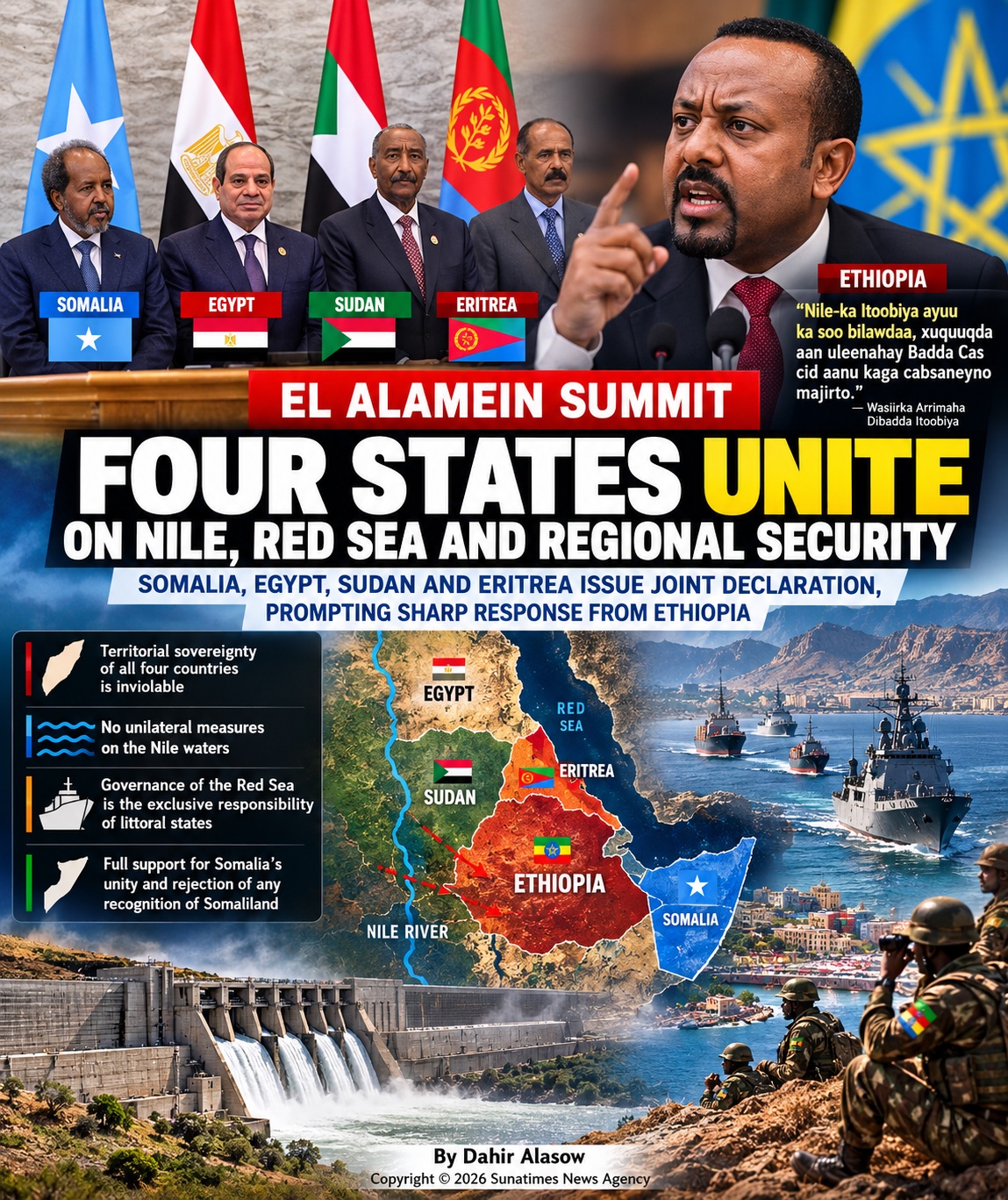

Egypt, Somalia, Sudan and Eritrea have formalised common positions on Red Sea governance, Nile waters and territorial sovereignty — prompting an unusually sharp response from Addis Ababa as Ethiopia fights a renewed war in the north
Sunatimes News Agency
Copyright © 2026 Sunatimes News Agency. All Rights Reserved.
NEW ALAMEIN / ADDIS ABABA — October 5, 2026 — A summit involving Egypt, Somalia, Sudan and Eritrea has produced one of the clearest coordinated regional positions yet on two issues at the heart of Ethiopia’s strategic ambitions: access to the Red Sea and control over the waters of the Nile.
Although Ethiopia was not named in the most sensitive clauses of the El Alamein Joint Declaration, an examination of the document, the geopolitical interests of the four participating states and Addis Ababa’s response less than 24 hours later leaves little doubt that Ethiopia understood important parts of the declaration as directly affecting its national interests.
The summit brought together Egyptian President Abdel Fattah el-Sisi, Somali President Hassan Sheikh Mohamud, Eritrean President Isaias Afwerki and Sudanese leader General Abdel Fattah al-Burhan in New Alamein, Egypt, on October 4.
Their declaration formally committed the four governments to continued consultation and coordination and established a mechanism for follow-up meetings. Presidency of Egypt
That provision is important.
El Alamein was not presented simply as a ceremonial gathering. The four states agreed to institutionalise their consultations, potentially creating an emerging diplomatic framework stretching from Egypt through Sudan and Eritrea to Somalia.
And geographically, Ethiopia sits at the centre of it.
Two Clauses Point Directly Toward Ethiopia's Strategic Agenda
Two provisions of the declaration stand out.
The first concerns the Red Sea.
The four governments affirmed freedom of navigation but declared that:
"the governance of the Red Sea is the exclusive responsibility of the littoral states.”
That language has major geopolitical significance.
Ethiopia is the most populous landlocked country in the world and has increasingly argued that its economic, demographic and security interests require reliable maritime access.
Addis Ababa lost its coastline following Eritrea's independence in 1993. Since then, Ethiopia has depended overwhelmingly on neighbouring countries—particularly Djibouti—for maritime trade.
The El Alamein declaration establishes a contrasting principle: decisions concerning governance of the Red Sea belong exclusively to countries possessing a coastline.
Egypt, Sudan, Eritrea and Somalia are all Red Sea or Red Sea-system littoral states. Ethiopia is not. Presidency of Egypt
The declaration therefore does not have to mention Ethiopia by name for its strategic implications to be apparent.
The Nile: Another Red Line
The second crucial provision concerns the Nile River.
The four governments called for international law governing transboundary rivers to be respected, specifically invoking the principle of avoiding harm and cooperation through prior notification, consultation and consensus.
More significantly, they categorically rejected unilateral measures harming the existing water uses of the Nile's two downstream states.
Those two states are Egypt and Sudan. Presidency of Egypt
Again, Ethiopia was not named.
But there is only one major contemporary dispute that makes this formulation geopolitically explosive: the long-running confrontation over Ethiopia's use of the Blue Nile and the Grand Ethiopian Renaissance Dam (GERD).
Egypt views the Nile as an existential national-security issue. Ethiopia, meanwhile, regards utilisation of the Blue Nile as a sovereign development right.
What makes El Alamein particularly significant is that Somalia and Eritrea have now joined Egypt and Sudan in endorsing language concerning unilateral Nile measures.
For Somalia, that represents participation in a regional declaration dealing with an issue that has traditionally been dominated by Cairo, Khartoum and Addis Ababa.
Addis Ababa Responds Within Hours
Ethiopia's reaction was rapid.
On October 5, the Ethiopian Ministry of Foreign Affairs issued a statement asserting Ethiopia's position on both subjects raised at El Alamein.
On the Nile, Addis Ababa emphasised that virtually all of the Abay, or Blue Nile, originates in the Ethiopian highlands and said it contributes approximately 85 percent of the Nile's total flow.
The government argued that discussions concerning utilisation and management of the river must take that geographic reality into account. ENA English
Then came the Red Sea.
Ethiopia declared that political borders had changed but that its historical and geographic relationship with the Red Sea remained.
Its nearest frontier, the Foreign Ministry noted, lies only about 30 miles — approximately 48 kilometres — from the coast.
Addis Ababa consequently argued that regional maritime discussions and security arrangements must recognise Ethiopia's "legitimate interests” in the Red Sea. ebc.et
The strongest passage followed.
The Ethiopian government said geographical and historical realities could not be changed by political rhetoric, coercive measures or destabilisation. It further warned against actions conducted through proxies or aggression, while also saying Ethiopia remained committed to peaceful engagement and regional cooperation. ebc.et
That language transformed what could have remained a diplomatic communiqué into a much sharper regional exchange.
Somalia Is Not a Spectator
Somalia's presence at El Alamein deserves particular attention.
Mogadishu did not merely attend the meeting. President Hassan Sheikh Mohamud joined the other leaders in adopting the declaration.
In return, the other three governments adopted language strongly supporting Somalia's territorial position.
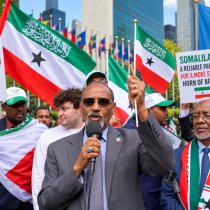
The declaration explicitly supports the unity, sovereignty and territorial integrity of the Federal Republic of Somalia and rejects recognition or support for Somaliland. Presidency of Egypt
This connects El Alamein to another dispute involving Ethiopia.
Relations between Somalia and Ethiopia deteriorated dramatically after Addis Ababa signed a memorandum of understanding with Somaliland in January 2024 concerning maritime access. Mogadishu regarded the agreement as an infringement of Somali sovereignty.
The Ankara Declaration of December 2024 subsequently helped ease that confrontation, with Somalia recognising Ethiopia's need for reliable commercial access to the sea while insisting that any arrangement respect Somali sovereignty.
President Hassan Sheikh has continued to say Somalia does not oppose Ethiopian commercial access through Somali ports when agreed with the Somali government. Al Jazeera
That distinction is critical.
The disagreement is therefore not simply about whether Ethiopia may trade through a port. It concerns sovereignty, jurisdiction and whether maritime access can translate into a sovereign foothold or role in Red Sea governance.
A Geographic Alignment Around Ethiopia
Look at a map and the strategic significance becomes clearer.
To Ethiopia's north lies Eritrea.
To its northwest lies Sudan.
Beyond Sudan lies Egypt.
To its east and southeast lies Somalia.
All four governments now have a formal mechanism for continued consultation.
Yet it would be premature to describe El Alamein as a formal military alliance. The published declaration does not establish a collective-defence pact, and the four governments have different national priorities.
There is nevertheless evidence of expanding strategic coordination among them, while Egypt has deepened security relationships in the Horn of Africa. Regional reporting ahead of the summit also described discussions about broader military cooperation. The National
The distinction matters: a coordinated diplomatic front is established by the declaration; a four-state military alliance is not.
The Timing Could Hardly Be More Sensitive
The summit took place while Ethiopia was experiencing another major military crisis.
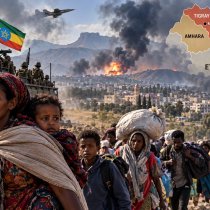
Federal and allied forces retook Mekelle, the capital of Tigray, on October 4 after renewed fighting involving an opposition alliance that includes the Tigray People's Liberation Front.
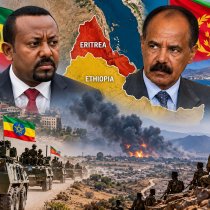
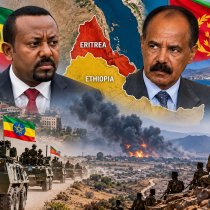
Addis Ababa has accused Eritrea, Sudan and Egypt of supporting forces fighting the Ethiopian government. Those governments have denied the accusations. Reuters
This means three of the governments sitting together at El Alamein were simultaneously being accused by Ethiopia of involvement—directly or indirectly—in the conflict threatening the federal government.
Against that background, phrases such as "proxies,” "aggression” and "destabilization” in Ethiopia's October 5 statement carry substantially greater significance.
They should not, however, be interpreted as proof of foreign military involvement. Ethiopia has made the accusations; the accused governments deny them.
Three Disputes Are Now Intersecting
What makes the present confrontation unusually dangerous is that several historically separate disputes are beginning to overlap.
The first is the Nile: Ethiopia versus Egypt and Sudan over water rights and GERD.
The second is the Red Sea: Ethiopia's search for dependable maritime access and a strategic role versus coastal states determined to preserve sovereignty over their territory and maritime governance.
The third is Ethiopia's internal war, where Addis Ababa believes some regional rivals are assisting its armed opponents—an allegation those states reject.
Somalia introduces another dimension: the territorial integrity and Somaliland question.
Eritrea adds another: deteriorating relations with its much larger southern neighbour.
Sudan adds both the Nile dispute and its own devastating civil war.
Egypt connects virtually all these theatres through its Nile security interests and expanding political and security relationships in the Horn.
The result is an increasingly interconnected regional security system in which a crisis originating in one arena can rapidly affect another.
El Alamein May Mark a Turning Point
The most consequential sentence in the declaration may ultimately not concern the Nile or even the Red Sea.
It is the agreement to create a mechanism to follow up the summit's decisions and to hold consultations periodically and whenever necessary. Presidency of Egypt
That creates the possibility that Egypt, Sudan, Eritrea and Somalia are moving from temporary convergence toward structured coordination.
Whether that develops into a durable strategic bloc remains uncertain.
But Ethiopia's immediate response demonstrates that Addis Ababa is paying close attention.
Within roughly a day of the four leaders establishing their common positions, Ethiopia publicly reasserted its claims and interests on precisely the two strategic questions addressed at El Alamein: the Nile and the Red Sea.
The emerging confrontation can therefore be reduced to two competing strategic propositions.
The El Alamein states insist that Red Sea governance belongs to its coastal states and that unilateral Nile measures harming downstream users are unacceptable.
Ethiopia responds that the Nile's geography begins overwhelmingly in its highlands and that neither modern borders nor diplomatic pressure can erase its historic and strategic connection to the Red Sea.
Neither side appears prepared to surrender those core positions.
And with Ethiopia simultaneously confronting renewed warfare at home, the dispute is no longer solely about a dam, a port or diplomatic language.
It is becoming a contest over the future balance of power across the Horn of Africa and the Red Sea.
By Dahir Alasow
Sunatimes News Agency
Copyright © 2026 Sunatimes News Agency. All Rights Reserved.

















The El Alamein Declaration: Four States Draw Red Lines Around Ethiopia as Nile and Red Sea Rivalries Converge
Egypt, Somalia, Sudan and Eritrea have formalised common positions on Red Sea governance, Nile waters and territorial sovereignty — prompting an unusually sharp response from Addis Ababa as Ethiopia fights a renewed war in the north