ALSO IN THE NEWS

Qatar Signals a Shift in Somalia's Gulf Alignment as Mogadishu Cuts Ties With UAE
 0
0
Tuesday January 13, 2026 - 00:40:52 in Latest News by Super Admin
- Visits: 2999
-

- Share

By Dahir Alasow | Waagacusub.net | Analysis
Doha statement contains a diplomatic clue
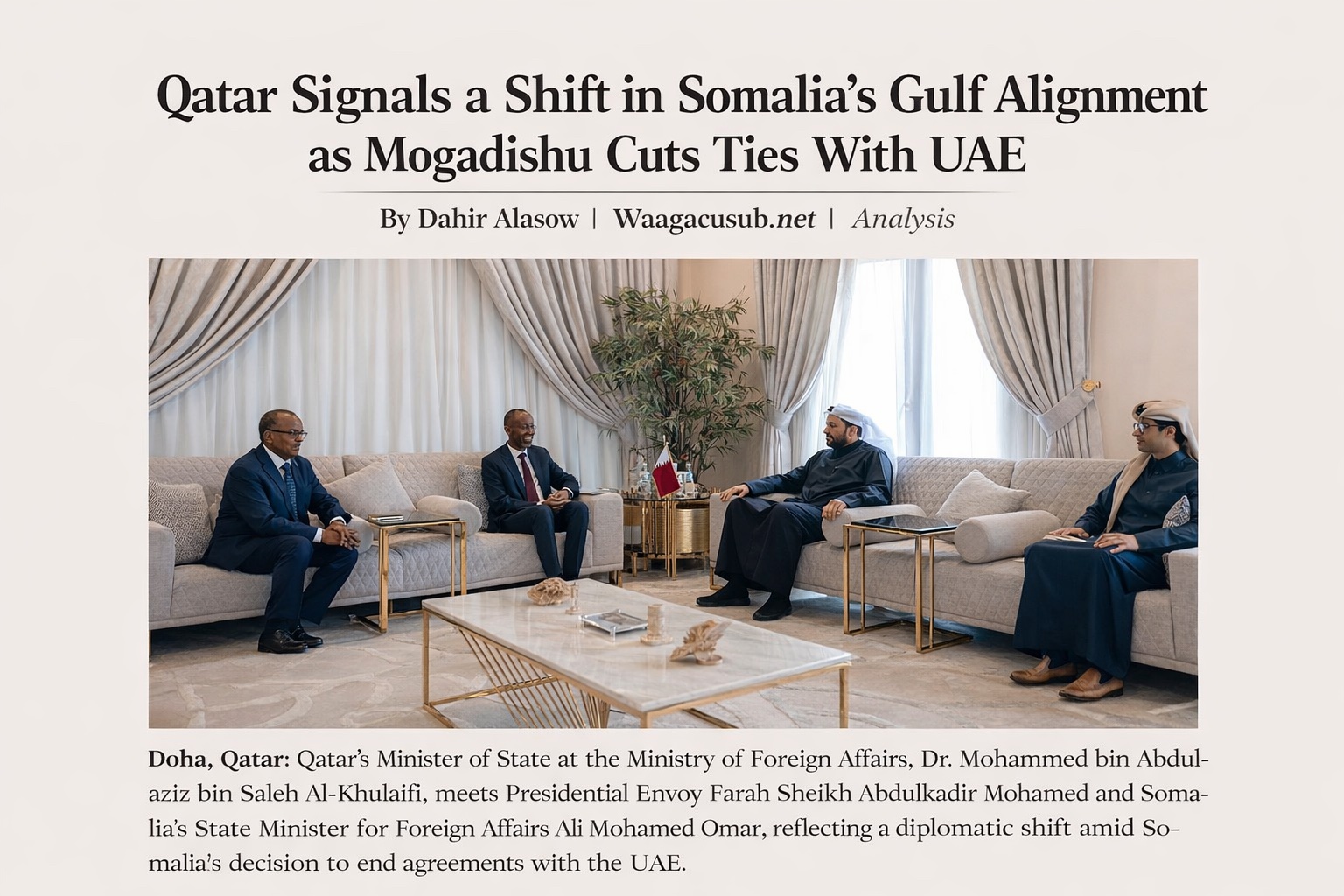
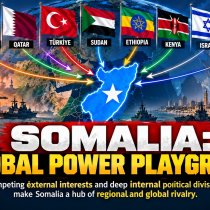
A recent official statement issued by Qatar's Ministry of Foreign Affairs in Doha (dated 12 January 2026) has revealed a notable diplomatic nuance that provides deeper insight into Somalia's rapidly evolving foreign policy — particularly following the Somali government's announcement that it has terminated security and cooperation agreements with the United Arab Emirates (UAE).
While the statement describes a high-level meeting between Qatar's Minister of State at the Ministry of Foreign Affairs, Dr. Mohammed bin Abdulaziz bin Saleh Al-Khulaifi, and Somali officials, the way Somali representatives were titled and introduced appears politically significant.
Why the titles matter: a deliberate message
internal stability,
Why the titles matter: a deliberate message
In the Qatar MoFA statement:
Somalia’s Minister of State for Foreign Affairs and International Cooperation was given his full official government title.
However, Somalia’s Minister of Education (Farah Sheikh Abdulkadir Mohamed) was referred to as:
"Presidential Envoy” (مبعوث الرئيس), meaning the President’s special representative.
This is unusual and revealing.
In normal diplomatic protocols, ministers are typically introduced with their official portfolios (Education Minister, Interior Minister, etc.). When a minister is instead presented as a Presidential Envoy, it usually indicates that:
The President has personally mandated the individual to carry a sensitive diplomatic message;
The mission may go beyond the ministry’s formal mandate (education in this case);
The envoy is operating with direct presidential authority — potentially bypassing routine governmental channels.
Somalia’s President appears to be running Gulf diplomacy personally
The Qatar statement suggests that Somalia’s President is not merely allowing the Foreign Ministry to manage regional alliances in the Gulf. Instead, he may be:
directing negotiations personally,
using trusted political figures as special envoys,
managing Gulf ties as a matter of national strategy, not routine diplomacy.
The education minister being framed as "Presidential Envoy” points to a high level of confidence from the President — and may also reflect political control and message discipline in Somalia’s foreign policy reorientation.
Context: Somalia ends UAE cooperation agreements
This diplomatic messaging comes at a time when Somalia has reportedly:
canceled security agreements with UAE-linked structures,
pulled out of several cooperation frameworks,
and shifted toward new Gulf partners, particularly Qatar and Saudi Arabia.
The Somali government’s latest move reflects not only a dispute with the UAE, but a geopolitical reset — as Mogadishu re-aligns toward states viewed as more supportive of Somalia’s sovereignty and internal stability.
What Qatar’s wording signals
Qatar’s statement reaffirmed its "firm position” supporting:
Somalia’s sovereignty,
unity,
and territorial integrity.
This language is highly relevant to Somalia today because it connects directly to sensitive issues including:
internal stability,
federal-state disputes,
and external interference.
In diplomatic terms, it serves as:
a political endorsement of Somalia’s federal government,
a reassurance that Qatar views Somalia’s unity as non-negotiable,
and an indirect contrast to rivals’ influence.
A replacement role: Doha stepping into UAE space?
Somalia’s termination of UAE agreements creates strategic vacuum, especially in:
military financing and stipends,
security cooperation,
training infrastructure,
and logistical support networks.
Regional sources increasingly suggest that Qatar may now expand its role — directly or indirectly — in supporting Somali state institutions, including financial and security coordination.
Even if not formally announced, the Doha statement indicates that Qatar is positioning itself as a central state partner in Somalia’s next phase of governance and security policy.
Conclusion: a diplomatic handover in the Gulf
Somalia’s decision to end cooperation agreements with the UAE marks a turning point. But Qatar’s statement adds a deeper layer: it shows Somalia is not only changing partners, but also changing how it conducts its diplomacy.
The use of a trusted minister as a Presidential Envoy reveals that the President is likely:
managing the Gulf file at the highest level,
reshaping alliances based on sovereignty and strategic leverage,
and preparing long-term repositioning toward Doha and Riyadh.
In short, Somalia’s break with the UAE is not a single event — it is part of a larger recalibration that could redefine Gulf influence in the Horn of Africa for years to come.







Qatar Signals a Shift in Somalia's Gulf Alignment as Mogadishu Cuts Ties With UAE
By Dahir Alasow | Waagacusub.net | Analysis Doha statement contains a diplomatic clue A recent official statement issued by Qatar's Ministry of Foreign Affairs in Doha (dated 12 January 2026) has revealed a notable diplomatic nuance that p