Mogadishu (Sunatimes) Following the London conference
on Somalia earlier this year in which the secessionist enclave called
“Somaliland” was rejected by the international community as a separate state, some
die-hard extremists in this camp are fighting tooth and nail to keep the
momentum of secession going even when things seem to be crumbling right on
their feet. In the aforementioned conference, the international community has clearly
reaffirmed its support for Somalia’s sovereignty and territorial integrity,
which dealt a mortal blow to the secessionist’s twenty-year long quest for a
separate statehood. Since the secessionist movement had not participated in the
Kampala Accord, Growe principles I and Growe Principles II, it was reasonably logic for the international community to call for a meeting
between “Somaliland” and the TFG to bring the former on board. Consequently, a
secessionist entity that refused to sit down with their fellow brethren time
and again for well over two long decades of misery, division, isolation and
economic doldrums had all of sudden initiated a unilateral dialogue with the
TFG with a minimum set of preconditions to the astonishment of everyone,
including their very own constituencies.
So why change of heart now?
As I mentioned many times on these pages the
secessionist enclave based in Hargeisa has always existed on the tenacity and
the undiminishing die-hard support and attitude of its largely one-clan constituency.
In the eyes of international community it was nothing but a separatist
movement. Lack of alternative government in the Somali capital was cited by
many observers as the reason why it lasted this long. Had peace prevailed in
Mogadishu years ago, “Somaliland” would have fallen like a house of cards. That
had almost happened when Islamic Courts Union (ICU) brought peace and normalcy to
Mogadishu in 2006, albeit brief. With the improving security situation in Mogadishu
following the ouster of the devious Al Shabaab group from almost all major
cities and towns in southern and central Somalia, the silent majority of
Northwestern regions of Somalia, particularly those from SSC, Awdal and Makhir were
presented a golden opportunity that they can ill-afford to squander it. And so they
dully grabbed it with both hands. Nothing short of Somali unity will satisfy
them.
Almost all representatives of the pro-unionist
communities are either in Mogadishu or on their way to the Somali capital to participate
the selection of new legislators and the formation of all inclusive government
that will lead the country in the next four years. Unfortunately, Awdal is an
exception as its clan chiefs were either bribed or put under a virtual house
arrest. Even the tribal chief of Ahmed Silanyo’s sub-clan is reported to have
landed in Mogadishu. This has sounded a wake-up call for the secessionist
authority and prompted its security apparatus to use all the tactics in the
book to intimidate and harass any clan chief suspected to be participating in the
Mogadishu conference. It was always obvious that an ill-advised and
ill-conceived state concocted at the barrel of gun, which has little or no
support from the pro-unionist communities, will fall into pieces once the circumstances
on the ground changes elsewhere. The scenario dreaded by the secessionists is
fast becoming a reality and hit home.
As I pen this piece, Hargiesa is hosting a meeting for
all clan chiefs in northern Somalia to ensure that they stay away from the
ongoing conference in Mogadishu. Funnily, this meeting is in all intents and
purposes reminiscent to a seminar the former government of Somalia had held for
the former Soviet military advisers stationed in Mogadishu so that the national
army would wage a liberation war against Mengistu Haile Mariam’s Derg regime in
Ethiopia.
In that seminar, senior members of the Supreme
Revolutionary Council (SRC) had to deliver lectures to the unsuspecting Soviet
military personnel for several weeks while the preparation of war was on full
swing on the backdrop. Ahmed Silanyo’s secessionist authority is using similar tactics
in the sense that clan chiefs will be entertained and dinned in Hargeisa while
their counterparts are reconstituting a government in Mogadishu. As progresses
are being made in Mogadishu and elsewhere in the south, Ahmed Silanyo’s
administration is becoming desperate by the hour and resorting to spiteful
tactics. His minister of interior warned the clan chiefs to expect a severe
punishment should they misstep. This is clear indication that “Somaliland” had
always stood on wobbly legs that would falter the sooner peace and tranquility takes
root in Mogadishu. In light of improving security situation in southern
Somalia, together with the worsening political, social and economic situation
in the secessionist enclave which is bereft of known natural resources, it
seems the much-vaunted, much-hyped “Somaliland” is crumbling right on Ahmed
Silanyo’s feet. Its days, as many predicted, may be numbered.
The way forward
Somaliland politicians are known for their brinkmanship
and emotional decision-making. Cracks are already appearing everywhere in the
enclave’s socio-political system, and people who were initially subscribed to
the secession project and held it dearly are for the first time questioning
whether it is worthwhile to continue this dead-end road. Twenty years of
isolation is taking its toll on the ordinary men and women in the street. Business
community, which prospered over the years, is frustrated about the lack of business
opportunity in the country. This is why Dahabshiil HQ is based in Djibouti and
not in Hargeisa. To ensure the continuation of the relative peace and
tranquility that prevailed in the enclave for the best part of the past two
decades, Ahmed Silanyo and his administration should grab the bull by the horn and
take bold and brave decisions in declaring the secession project nil and void (untenable)
and start serious negotiations with his counterparts in Mogadishu. No part of
Somalia is dispensable and “Somaliland” is no exception. The enclave can play a
significant role in the reconstitution of Somali state should their leaders have
the guts and courage to take the plunge. The provisional Somali constitution,
yet to be endorsed, has provisions for “Somaliland” should they decide to stay with
their brethren. Failure to do so would mean the enclave sliding further into
chaos and inevitably disintegrating into warring tribes as current events in
Awdal, Las Anod and elsewhere illustrate. Hargeisa and Burao are no immune to such
a chaos. Having largely been peaceful in the middle of chaotic but improving
Somalia, the enclave has nothing to lose and everything to gain to remain an
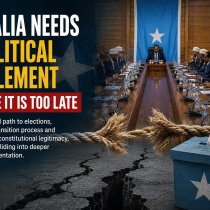
integral part of Somalia. The way forward for “Somaliland” politicians is to
start a meaningful and constructive dialogue with their fellow Somalis before it
is too late. The secession is doomed.
Mohamed F Yabarag
myabarag@yahoo.co.uk